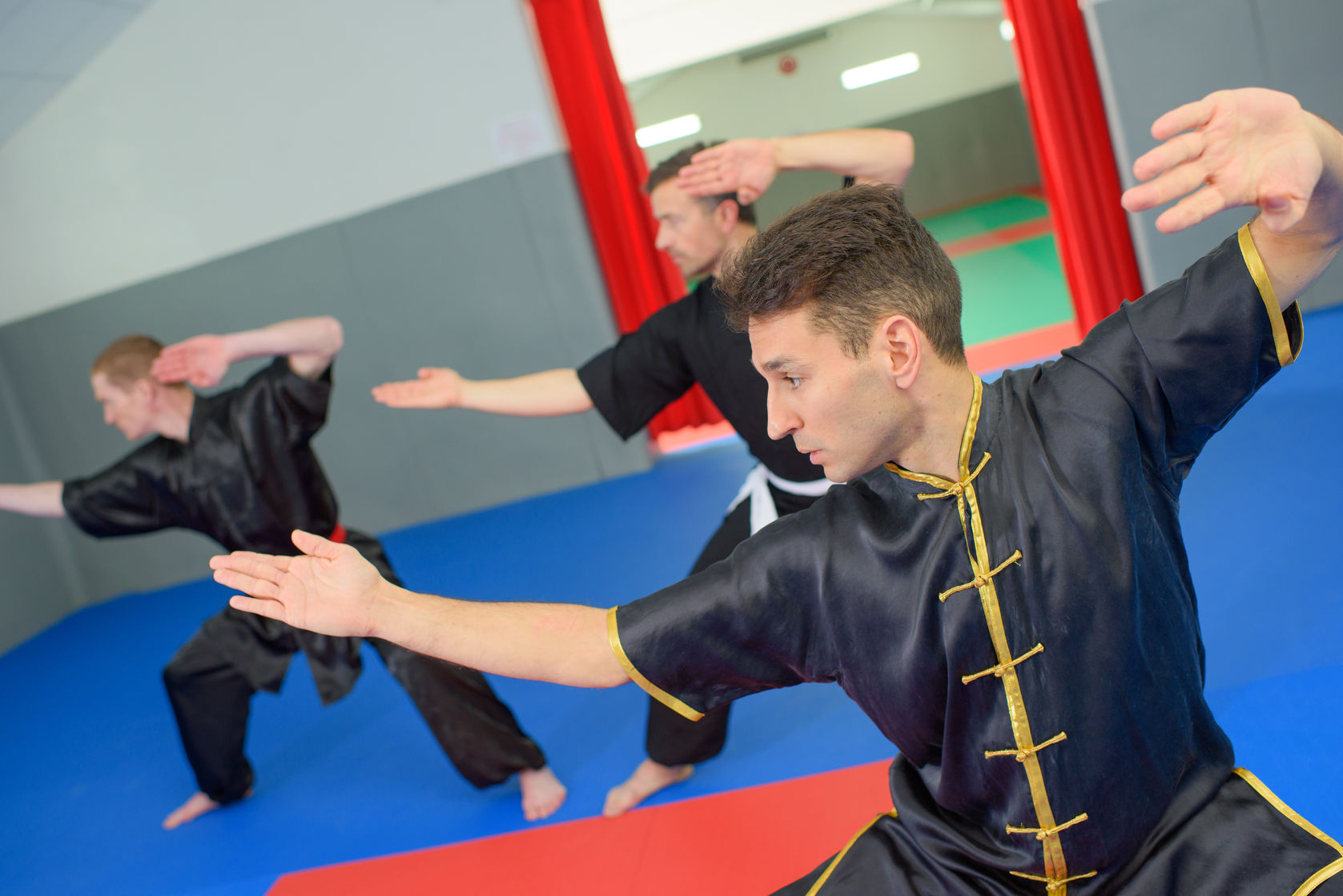
Most Martial Arts styles, especially Chinese martial arts, have formal routines. These routines are the encyclopedia of Kung Fu techniques. Forms contain all the basics, self-defense, and fighting strategies. Forms also teach you to move from one technique to another and improve flexibility, strength, concentration, and endurance.
Forms are style-specific. What I mean is that the techniques in each form are specific to that style and its movement strategies. For example, Praying Mantis forms differ from Hung Gar (Tiger Crane Forms), which differ from Eagle Claw. Each style of Kung Fu uses different types of hand, foot, and blocking techniques. The forms exemplify the flavor of the method. Mantis forms are quick and fast, using the Mantis claw to trap and unbalance the opponent. Hung Gar forms use more stationary stances with lower kicks, and the hand forms emphasize the claw of the Tiger that the practitioner uses for striking and clawing an opponent. Eagle Claw uses long-range, flowing hand techniques to block and trap opponents with its claws, applying locking and pressure-point techniques.
The techniques taught in the forms are for fighting and self-defense. By learning the techniques within the formal routines, you’re also improving your fighting and self-defense skills. You’re practicing and refining your methods: punching, blocking, kicking, etc. You develop speed, power, timing, concentration, strength, and flexibility.
Forms teach you to move fluidly from one move to another with many different stances and combination techniques. These routines prepare you to defend yourself against multiple opponents from various directions. You learn evasion, using postures to unbalance opponents, vital points, proper power points, and when to use kicks and punches, depending on the Critical Distance Line.
Forms improve concentration by forcing your mind to remember a series of movements. However, this concentration involves more than just the mind. The body also takes part in muscle memory. Sometimes, when practicing a routine, the mind loses focus, only to be carried on by the body through muscle memory. I often urge students to refine their stances or techniques because, when there’s no specific stance or method associated with a movement, the body has trouble deciding what to do next. Thus, routines build harmony between mind and body.
Coordination is another critical element developed through forms. Many students have excellent coordination when performing specific techniques, such as a punch or a block-and-punch, but need help with routines. Forms require a higher degree of coordination than individual movements. Coordination involves the hands, hips, and legs for stances and kicks. Coordination leads to smoother execution of techniques and more power generation because the muscles cooperate rather than against each other. The student must continually learn to coordinate different stances and techniques throughout the routine because of the variety of techniques and the continuous transition from one method to the next. Routines take years of practice to master. Each routine has its own specialized movements, so each form is unique in developing coordination skills.
Forms took years to develop, with each master incorporating new thoughts and ideas into the style. A simple explanation for development was that someone got attacked. He then produced a block and counter for that attack and practiced these two techniques. If he gets attacked again and someone counters the striking technique, he later develops another block and counter. A master could also take a specific principle from the system, such as evasion, and develop an entire routine emphasizing that characteristic.
Many Kung Fu forms were also animal-specific. For example, the Eagle Claw has a Leopard form. This routine doesn’t use the half-clenched fist but emphasizes the Leopard’s speed. Eagle Claw’s Tiger form emphasizes the strength and power of the Tiger rather than the clawing hand techniques used in the Tiger claw system.