Get 1 FREE Trial Class
What You Will Develop:
© Rothrock's Kung Fu & Tai Chi. All Rights Reserved. 412.381.6160
OptimizePress Popup Overlay
OptimizePress Popup Overlay.
Written History of Kung Fu
Quick Historical Reference
2600 BC - Huang Ti (The Yellow Emperor) Chiou Ti Kung Fu
206 BC - 220 AD - Chi Chi
220 AD - Long Hand Chi Chi
195-265 AD - Huo To: Frolics of the Five Animals
481-557 AD - Bodhidharma, Eighteen Movements of the Arhat's Hands
705-907 A.D. - Sze Hung Pei, Feinting Hand
960-1127 AD - Sung Tai Jo, Long Fist
1103-1142 AD - Yao Fei, Eagle Claw System
1417-1459 AD - Chang San Feng, Soft Fist
1522-1566 AD - Chueh Yuan, Pai Yu Feng, Li: Five Formed Fist
1644 AD - Destruction of the first Shaolin Temple
1600's AD - Beginnings of Okinawan Te and development of Jui Jutsu in Japan
1637-1661 - Chi Lung Feng, Hsing I
1700's - Yun Wing Chun, Wing Chun
1882 - Jigero Kano, Judo
1917 - Funakoshi Gichen, Shotokan Karate
1950 - Korean, Tai Kwon Do
History of Kung Fu
Kung Fu developed unlike many other fighting arts worldwide. The Romans, Egyptians, and even the knights of England and Europe had some form of fighting style. These were basic movements of block and strike, often using weapons. Today, we can see this with fencing and boxing. Only the Chinese arts develop highly stylized self-practice routines, both with open-hand fighting techniques and with weapons. As for the question of why, it seems the Chinese arts are also health-related because they developed from health-related practices.
Chinese fighting arts have many names - Kung Fu, Chuan Fa, Wu Shu, Kempo, etc. The name used to refer to Chinese Martial Arts is of little importance compared to the techniques it embodies. For our purposes, we designate Kung Fu as the comprehensive term used for Chinese Martial Arts.
Kung Fu underwent its early development within the walls of the Chinese monasteries. The monks possessed the time and learned natures to refine and synthesize the combative arts.
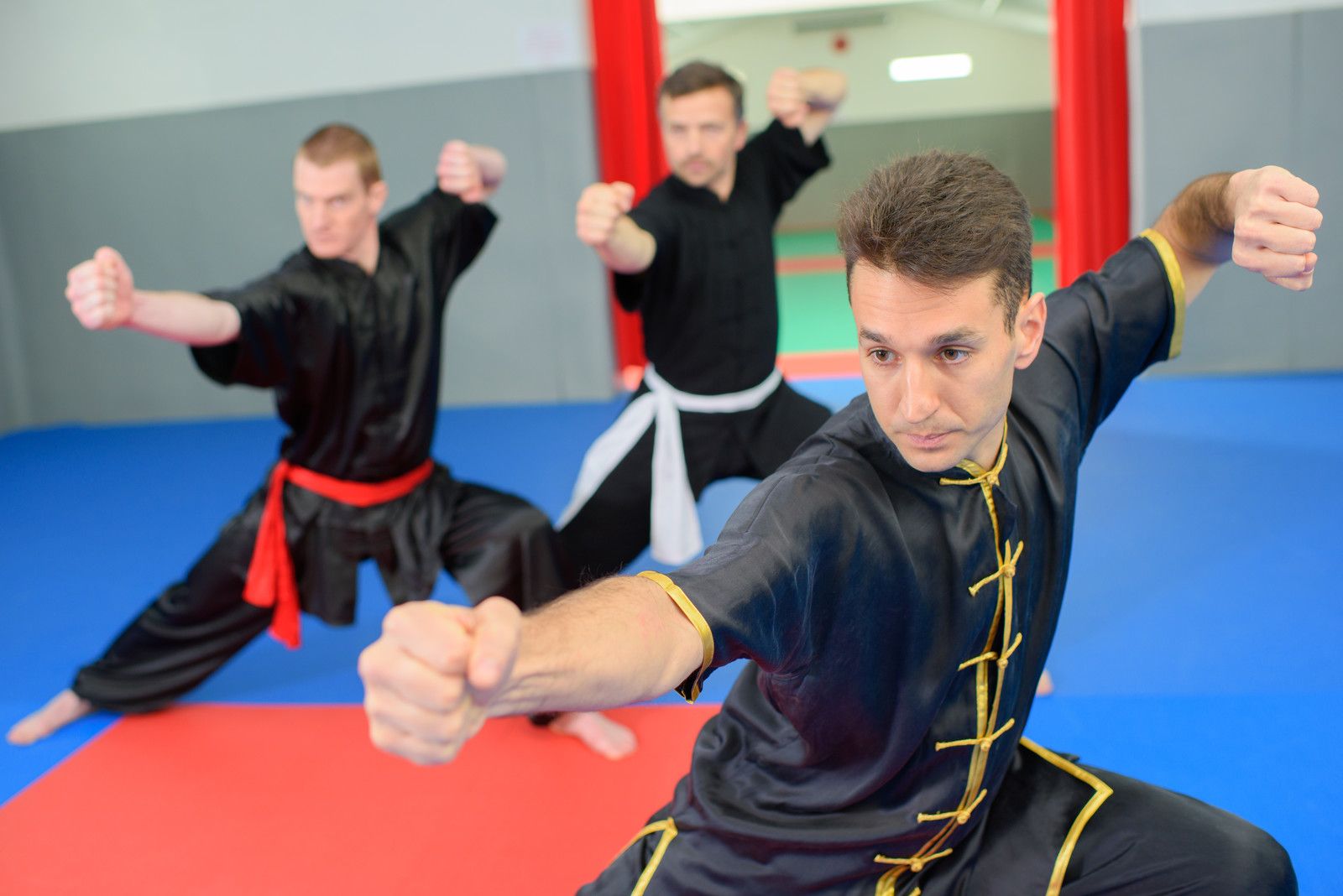
The northern style of Kung Fu was developed in the most famous monastery in China, called ‘Shaolin’ (Young Forest). This is where Kung Fu was first developed, about 500 AD. The monks developed and cataloged techniques based on the movements they studied for health and self-defense from the Tiger, Crane, Leopard, Snake, and Dragon styles.
The earliest recorded Kung-Fu-like movements were in the Yellow Emperor’s book on Chinese medicine, dating to about 2600 B.C. In this book, he lists several Kung Fu- like exercises for maintaining health.
The bloody sport of go-ti, a routine of hand-to-hand combat and wrestling, is believed by some experts to be the most original form of Kung Fu. This sport was invented by the evil warlord Chi-yu around 2600 B.C. He invented a sadistic game in which his soldiers were forced to fight each other with helmets that sported two long, sharp horns. The object of the game was to gore the opponent, hence the name go-ti, which means horn gore. To escape being gored called for some fancy footwork, which in turn led to the beginning of unarmed self-defense.
In time, the sport go-ti was modified, and the horns were removed. Civilians began practicing go-ti, and the tradition was passed down from generation to generation. While go-ti, as originally formulated, is no longer practiced today, during festivals the natives of Honan, Manchuria, and Shansi still entertain themselves with an ancient go-ti dance that simulates the original combat routine.
In 500 B.C., Tao Te Ching (The Way and the Power) of Lao Tzu came into routine. Contemporary with Confucius, Lao Tzu wrote the Tao Te Ching, a collection of poetic passages that sets forth the wisdom of Taoism. It is essentially a philosophic system rather than a religious one. Taoism is a way of achieving higher states of consciousness. Lao Tzu's wisdom was rapidly incorporated into the emerging schools of Kung Fu, and from then on the two disciplines grew side by side, at times meshing completely. Both schools developed into systems which encompassed breath control, meditation, physical exercises, medical practices, alchemy and scholarship.
Taoist monks became Kung Fu experts in all routines of combat, although they were particularly recognized for their speedy proficiency with swords and other weapons. In turn, kung fu men drew inspiration from Taoist ways and lived their lives by its dictates. It is assumed that this era saw the formulation of the Kung Fu code, which called for protecting the weak and punishing evildoers.
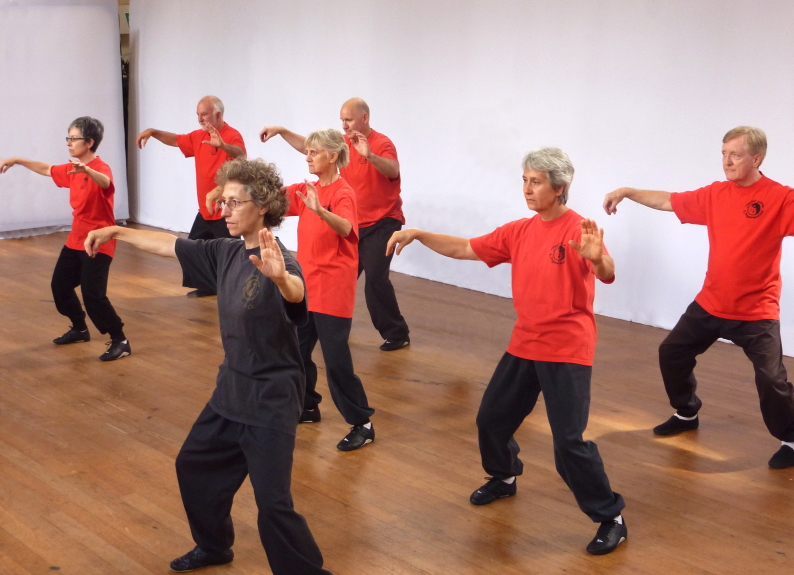
The Tao Te Ching served as the central philosophy not only in Kung Fu but also in many internal styles, such as Tai Chi. The Taoists believed that everything in nature is composed of two parts: Yin and Yang. These two parts make a whole, represented by a circle with one side dark and the other light. Each side also contains a small circle of the opposite side. The Yang represents light and strength. The Yin represents darkness and relaxation. Neither is more powerful than the other. For all living things, these two parts must always be in balance.
Kung Fu and Tai Chi incorporated these things into their techniques. To have power, the techniques were circular and used both parts of the yin/yang principle. In other words, when you perform a circular technique, one part of the circle should be relaxed and inactive while the other part of the circle is active and has power. Combining these two forces within the technique helps a practitioner generate tremendous power.
In the Han Dynasty (A.D. 25-200), the famous surgeon Hua To originated a series of exercises based on the movements of five animals: tiger, deer, bear, monkey, and bird. These exercises were devoted to keeping his patients healthy. He based the exercises on various animals because they were more attuned to nature and had fewer illnesses. By mimicking the movements of the various animals, one could maintain one's health. Each animal was devoted to a certain aspect of health.
Around 220 A.D., Emperor Han Wu Ti was a devotee of boxing and wrestling. The Han Shi I Wen Chi (Han Book of Arts) contained chapters on hand-to-hand fighting. This book devotes four chapters to kung fu strategy, covering configuration, the principles of nature, and skill. The skill chapter is 199 pages long and deals in considerable detail with hand-to-hand combat, fencing, exercises utilizing the arms and legs, the use of a wide variety of weapons, and ways to lead an enemy into a trap.
It was also during this period that Kwok Yee developed the art of Chi Chi. This style was designed to subdue opponents at a greater range than in hand-to-hand combat. Longhand rapidly became the predominant routine and enjoyed considerable refinement. Master became so skilled in this style that Emperor Niwanti (535-551 A.D.) wrote in his book Classic Literature that the long-hand technique enabled the practitioner to defeat heavily armed opponents with his bare hands.
This developed the concept of fighting from a distance, rather than the crowded, hand-to-hand techniques which had developed from go-ti and ch'ih yu-hsi. By preventing his opponents from closing in while striking hard at arm's length, Kwok Yee initiated a style which rapidly gained popularity among his contemporaries. Primarily a defensive tactic, but deadly to those unfamiliar with such maneuvers, Long Hand underwent a series of refinements and improvements until the sixth century A.D. It was recorded that a skilled exponent could defeat even heavily armed adversaries with little more than bare hands and feet.
Though different styles and ideas for health and pugilism developed during China’s long history, it wasn’t until about 500 A.D. that the martial arts were organized and written about in detail. This came about by the monks at the Shaolin temple located in the Honan province.
A Buddhist monk named Ta Mo traveled to the Shaolin monastery to deepen the monks’ understanding of Buddhism. He discovered that the monks fell asleep during the long hours of meditation. He incorporated a series of exercises to strengthen both the mind and the body. These became known as “The Muscle Change Classic” and “The Marrow Washing Course.”
The monks later expounded on these techniques by watching various animals. They used five major animals: the tiger, snake, dragon, leopard, and crane. Each animal developed different essences for health within the individual.
The dragon movements were devised to develop alertness and concentration. These movements were executed without the application of strength, with emphasis on breathing in the lower abdomen and on the coordination of mind, body, and spirit. Movements are long, flowing, and continuous, and provide Shaolin practitioners with the equivalent of tai chi or pakua.
The tiger's movements develop bones, tendons, and muscles. The execution of these movements was the opposite of that of the dragon, since emphasis was placed on strength and dynamic tension. Movements are short, snappy, and forceful.
The snake movements were used to develop temperament and endurance. Breathing was done slowly, deeply, softly, and harmoniously. Movements are flowing and rippling with emphasis on the fingers.
The crane movements were used to develop control, character, and spirit. Emphasis is placed on light, rapid footwork and evasive attacking techniques. Movements in the one-legged stance are performed with considerable meditation.
The leopard's movements develop quick speed. The hand formed a half fist. The movements are quick and snappy, and they develop the arms and shoulders. The footwork used many short postures and jumps to develop leg strength and flexibility.
Later, it was discovered that these movements could be used for self-defense. Monks would travel to nearby towns for food and to help people. They were attacked by bandits, who tried to rob them of their small packets of food or a few coins they had collected for services.
The news of their fighting skills traveled throughout the kingdom, and the system became known as the Shaolin Five Formed Fist. The monks recorded their movements and methods in a secret library. Monks who wanted to learn the Five Formed Fist went through years of mental training before learning the secrets of the Five Formed Fist.
To graduate from the temple, the monks passed through a hallway lined with the Shaolin Wooden Men. It is uncertain if these were real monks or wooden dummies. The monks traveled through this hall and were attacked from all different angles. Many did not survive.
If they made it through this gauntlet of attackers, there was a five-hundred-pound urn (containing hot coals) at the end of the hallway. The monks placed their arms against the urn and lifted it off a special stool. This opened a door to the outside world, but it also branded a dragon and a tiger on their arms. This marked them as Shaolin priests.
Later, two fighters named Li and Yuan traveled to the monastery and increased the number of fighting techniques to 72. The emphasis was on improving the fighting techniques rather than the meditative health movements within each animal. Thus, many of the deadly fighting techniques were hidden within the health movements. This can still be seen today in many animal routines.
Li and Yuan were also skilled with a variety of weapons, such as the broadsword, straight sword, and spear. They taught the monks how to use this variety of weapons, thereby expanding their deadly fighting abilities.
Nearly two-thirds of the Shaolin systems seem to have come from these animals, and they were further systematized by men who originated and performed profusely in one or more of these various animal movements. From them are the five names which are now famous: hung, fut, mak, choy, and li.
Hung is based primarily on power and long-hand techniques. Fut is primarily short-hand with slicing and tripping. Mak is a long-hand style with kicks and breaking. Choy has speedy, snake-like hand and body movements. Li represents short-hand movements with many pokes and slaps.
In the 1600's, the Manchus invaded China. Because they feared the Shaolin monks' skills, they burned down the temple. Many of the monks fled south and set up pockets of resistance by teaching people in various towns. They developed a secret sign to symbolize their status as resistance fighters: forming a fist with the right hand and placing the left hand on top. The fist represented the strength and power of Shaolin, and the left hand at the top represented the strength of mind to control and use the techniques for good, as well as to keep them secret.
During this time, many businessmen traveled to Okinawa. They showed a few of these techniques to the Okinawans, who formed their own methods of combat. They called their method simply ‘kara-te,’ which means ‘China hand technique.’ Later styles developed, such as Shorin-ryu (Shaolin Fist style), Goju-ryu (Hard Soft Style), and Isshinryu (One Heart Way). Later, these styles migrated to Japan and Korea. These people changed techniques to fit their way of life and their mentality.
In the 1800's, Kung Fu was brought to the United States by Chinese immigrants. Many of these immigrants worked on building the railroads' infrastructure. They would practice their arts in secret and kept their skills and styles within a family. To further keep these arts secret, the Chinese families would skip a generation. In other words, the grandfather would teach the grandson.
In the early sixties, a few Kung Fu schools opened in the Chinatown districts of New York City and San Francisco. These schools only taught Chinese people. It wasn’t until the late sixties, with the advent of Kung Fu movies and Bruce Lee, that a few Chinese masters decided to share their arts with Westerners. They still keep their secrets from Westerners. Even today, that thought still pervades the Chinese Kung Fu community.
There are many reasons for this, but most masters want to test a student’s loyalty to ensure that he is part of the family and will treasure the secrets the master eventually shares. The master has the student training for 20 or 30 years before sharing any secrets, let alone completing the system. Most students fail this test and leave their master's program, falsely believing they know the entire system and its secrets. I know several very good Western Kung Fu students who have studied for 20 years and have only learned 10 things from their teacher. When these students see some of the Chinese students, who train separately, they see many routines and movements that their masters have not shared with them yet. Another very famous Kung Fu master here in the United States, who has taught many students, still hasn’t shared one secret from the system he teaches. It’s no wonder none of his students can reach his skill level, even though he’s in his 80s.
Master Rothrock is one who has stood the test of time. He trained with Grandmaster Leung Shum for 25 years before the Grandmaster revealed the secrets and completed the Eagle Claw system with him. Master Rothrock has also completed the entire Yang and Wu Tai Chi systems under the Grandmaster. The Grandmaster has formally announced that he has passed all his knowledge to Master Rothrock.
Today, Kung Fu is divided into two groups: traditional Kung Fu and modern Wushu. Traditional Kung Fu schools teach methods passed down from their masters and grandmasters. The Wu Shu schools teach the modernized version developed in China for competition and exhibitions. Kung Fu schools, either Wu Shu or the traditional Kung Fu, are not as prevalent as schools teaching the many systems of Karate. The reason for this is that Kung Fu is much more complex than Karate and requires more years of study to become a qualified instructor. It is my hope to reach more people to introduce them to Kung Fu, so the art stays alive and well. I wish you luck in your Kung Fu journey.
OptimizePress Popup Overlay
OptimizePress Popup Overlay.
REGISTER YOUR SPOT NOW
Enter your details below to get a Risk Free Trial Course
OptimizePress Popup Overlay
OptimizePress Popup Overlay.
Send Us an Email
Have a Question? Just Send us a Quick Email for the answer.
We process your personal data as stated in our Privacy Policy. You may withdraw your consent at any time by clicking the unsubscribe link at the bottom of any of our emails.